
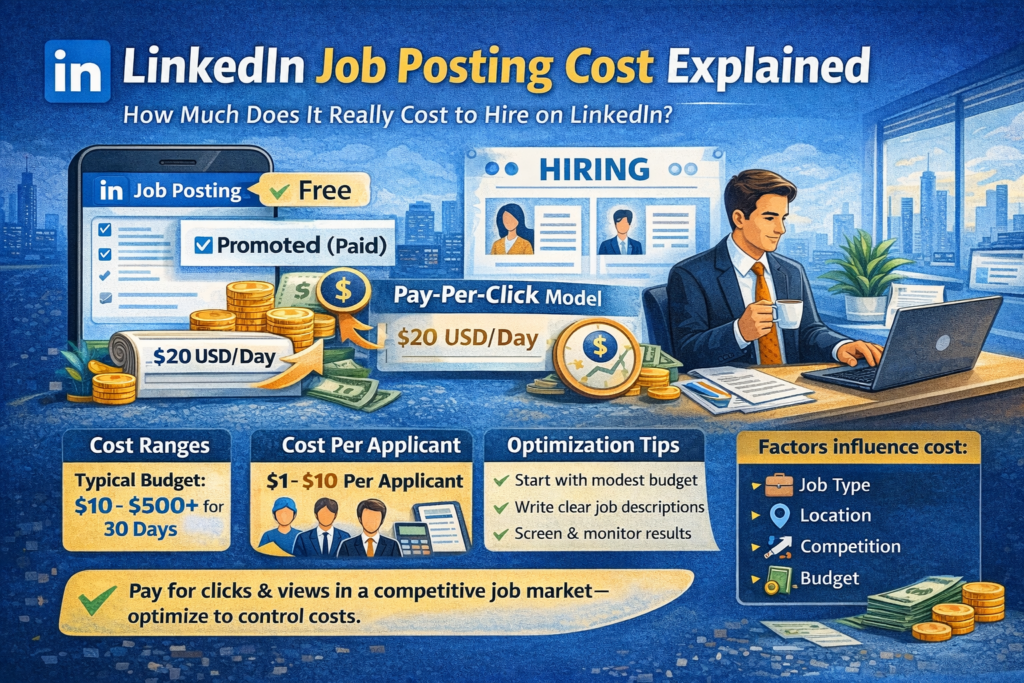
LinkedIn job posting cost, “How much does it really cost to post a job on LinkedIn?” you’re not alone. LinkedIn is one of the most powerful platforms for recruitment, but its pricing can feel confusing because it’s not a simple flat fee. Instead, costs vary based on your choices, your location, the role, and whether you stick with a free listing or promote your job.
Below is a clear, conversational breakdown of LinkedIn job posting costs, how pricing works, and what you should know before you spend a single rupee, dollar, or euro.
1. What Does It Cost to Post a Job on LinkedIn?
LinkedIn offers both free job posts and paid (promoted) job posts. In most regions, you can post at least one job for free, but if you want more visibility and applicants, you’ll likely end up using paid promotion.
-
A basic job post can be created at no upfront cost in many cases. You publish it, and candidates can apply directly.
-
For more reach, you can promote the job, and then LinkedIn charges you based on clicks or views in a pay-per-click style model.
In other words: you can “get on the platform” for free, but you pay when you want speed, visibility, and volume.
2. Free vs Paid Job Posts: What’s the Difference?
On paper, “free” sounds perfect. In reality, it’s often just a starting point.
Free Job Posting:
-
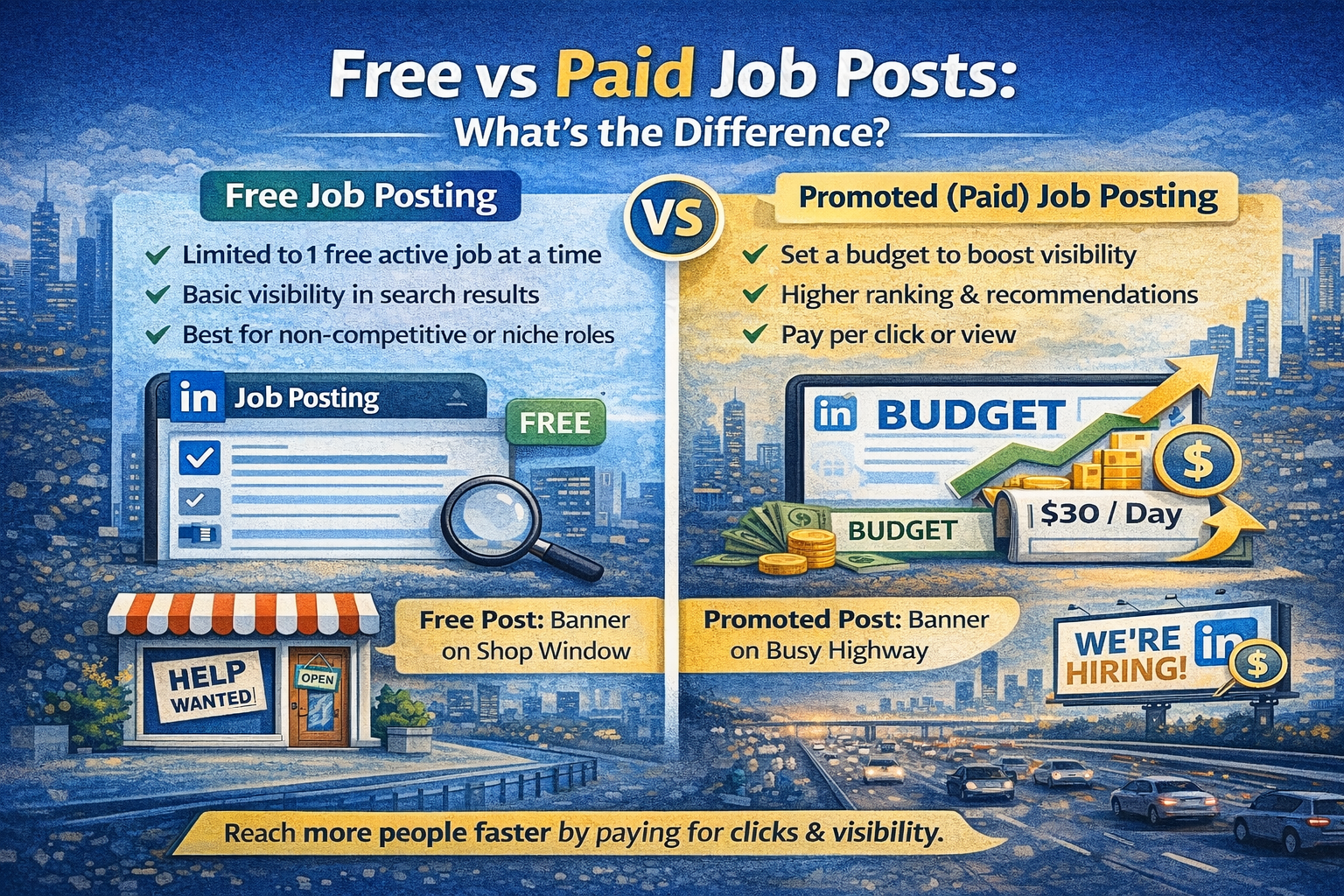
Usually limited to one active free job at a time for small employers.
-
Gets basic visibility in LinkedIn’s job search results.
-
Works best for roles that are not extremely competitive or niche.
Promoted (Paid) Job Posting:
-
You set a daily or total budget for the promotion.
-
LinkedIn boosts your job’s visibility to more relevant candidates.
-
Your listing appears higher in search results and can be shown to people via recommendations or job alerts.
-
You’re charged when people click or interact with your listing.
Think of the free post as putting a banner on your shop window, while a promoted post is like putting that banner on a busy highway.
3. How LinkedIn’s Pricing Model Actually Works
LinkedIn does not usually charge a simple flat fee per job post. Instead, it uses a pay-per-click / pay-per-view style model for promoted jobs.
Here’s the basic idea:
-
You choose a daily budget (e.g., 10, 20, or 30 units of your local currency per day).
-
LinkedIn shows your job to more people until your budget is spent.
-
You’re charged when people click on or view your job listing.
For example, if you set a 30‑day campaign with a daily budget of 10 (say 10 USD), LinkedIn indicates you won’t be charged more than 15 in a single day or more than 300 over 30 days; if it overshoots on one day, it adjusts on other days so your total stays within your limit. LinkedIn job posting cost
There are also enterprise-style contracts where large companies negotiate volume pricing for ongoing job posting and promotion, but those are usually custom and significantly more expensive.
4. Typical Cost Range for LinkedIn Job Posts
Because costs depend on competition, job type, and location, there’s no single universal price. That said, some useful ballpark ranges exist:
-
For many small and mid-sized employers, promoted job posts often cost somewhere between 10 and 500+ (in local currency) for a 30‑day promotion, depending on how aggressive the budget is.
-
In some enterprise agreements, companies can pay 1,500 to 3,000 per job for premium contracted posting and promotion over a set period.
You can think of it like an auction: if you’re hiring for a high-demand role in a competitive location (like a senior engineer in New York or London), you may need a higher budget to reach enough candidates.
5. Cost Per Click and Cost Per Applicant
Instead of focusing only on total budget, it’s helpful to think in terms of cost per click and cost per applicant.
-
Cost per click (CPC): LinkedIn uses an algorithm that considers job location, competition, and demand in that category. Your CPC fluctuates based on how many similar jobs are live and how many employers are bidding for attention.
-
Cost per applicant: This is what you actually pay per candidate who applies. It varies widely by profession. One analysis showed approximate costs per applicant in the US like: around 1.45 for nurses, 2.71 for software engineers, and 3.56 for sales roles, with higher costs for more competitive or specialized roles.
If you’re budgeting, cost per applicant is the number that really matters because it tells you how expensive each potential hire is to attract.
6. Factors That Influence LinkedIn Job Posting Cost
Why does your friend pay one amount to promote a job, and you pay something totally different? Because LinkedIn pricing is dynamic and influenced by several factors:
-
Job title and profession – High-demand roles (engineers, data scientists, some sales roles) can cost more per applicant than lower-competition positions.
-
Location – Big cities or tech hubs with many employers and active job markets typically cost more than smaller or less competitive regions.
-
Remote vs on-site – Attractive remote roles can draw more clicks and applicants, affecting cost dynamics.
-
Competition at that moment – If many companies are hiring for similar roles in your region, CPC can rise.
-
Your budget and bid – If your daily budget is low and competition is high, your job might get fewer impressions. If you set a higher budget, LinkedIn can push your job more aggressively.
Think of it like online ads: the more people are bidding for attention in your niche, the more it costs to stand out.
7. LinkedIn Recruiter vs Job Posting Costs
It’s important not to confuse job posting costs with LinkedIn Recruiter subscriptions. These are related but separate.
-
A job posting (free or promoted) is about putting a role on the platform for candidates to apply to.
-
LinkedIn Recruiter is a premium tool that lets you search and directly contact candidates in the LinkedIn database.
The pricing for LinkedIn Recruiter is much higher:
-
Recruiter Lite is typically around 170 per month or roughly 1,400–1,600 per year for a single license.
-
Recruiter Corporate can cost around 8,999 per year per seat or roughly 900–1,080 per month, with some sources estimating up to 10,800–12,960 per seat annually depending on configuration.
On top of that, there may be costs for extra InMail messages or promoted job posts used alongside Recruiter.
If you’re a small employer just trying to post one or two jobs, you usually don’t need Recruiter Corporate; a free or promoted job post is often enough.
8. Enterprise Agreements and Hidden Costs
Bigger organizations often use enterprise contracts that bundle job postings, promotion, and/or Recruiter seats. Here, the price per post can look dramatically higher on paper, but they’re buying reach and features at scale.
Some analyses suggest that contracted job posts for large companies can come out to 1,500–3,000 per job for a limited active period. That may include advanced distribution, priority placement, and tools that smaller employers never see.
There are also “hidden” or indirect costs to consider:
-
Time spent by recruiters manually sourcing candidates.
-
Extra InMails purchased at about 10 per extra credit in some setups.
-
Additional promotions or re-listings for hard-to-fill roles.
So while a single promoted job for a small business might sit comfortably in the 10–500 range for a month, a large-scale, always-on recruitment operation can end up spending tens of thousands per year across tools and posts.
9. How to Control and Optimize Your LinkedIn Job Posting Spend
If you’re worried about costs getting out of hand, there are several tactics to stay in control:
-
Start with a modest daily budget
You can test performance at a lower daily spend, then raise it if your cost per applicant looks healthy. -
Write a targeted, clear job description
The clearer the role and requirements, the more relevant clicks you get—and fewer wasted views from the wrong people. -
Use screening questions
This helps filter applicants, so you spend less time on poor-fit candidates and more on serious prospects. -
Monitor performance regularly
Check how many views, clicks, and applications your job is getting, and adjust your budget if results are too slow or too expensive. -
Pause or tweak when needed
If your job burns budget without delivering quality applicants, consider updating the title, description, or targeting.
Remember, the goal isn’t just cheap clicks. It’s qualified applicants at a reasonable cost.
10. Is LinkedIn Job Posting Worth the Cost?
So, is it worth paying to promote a job on LinkedIn?
In many cases, yes—especially for:
-
Professional, white-collar roles
-
Specialized roles where LinkedIn’s user base is strong
-
B2B roles where networking and industry connections matter
LinkedIn job posting cost is often one of the best places to reach experienced professionals, and a single good hire usually justifies the cost of promotion. But for very high-volume or low-margin roles, you might want to compare LinkedIn’s cost per applicant with other platforms and job boards.
Conclusion
LinkedIn job posting cost isn’t a straightforward, one-size-fits-all number. Instead of a fixed fee, it uses a flexible model that depends on your budget, your job type, and your market:
- You can often post at least one job for free, but visibility is limited.business.
- Promoted posts use a daily budget and pay-per-click style system, with typical 30‑day costs ranging roughly from tens to several hundred units for small employers—and much more for large contracts.
- The real value lies in cost per applicant and the quality of candidates you receive.
If you approach LinkedIn job posting with a clear budget, solid job description, and an eye on performance data, you can use the platform effectively without overspending—and find the right people faster.