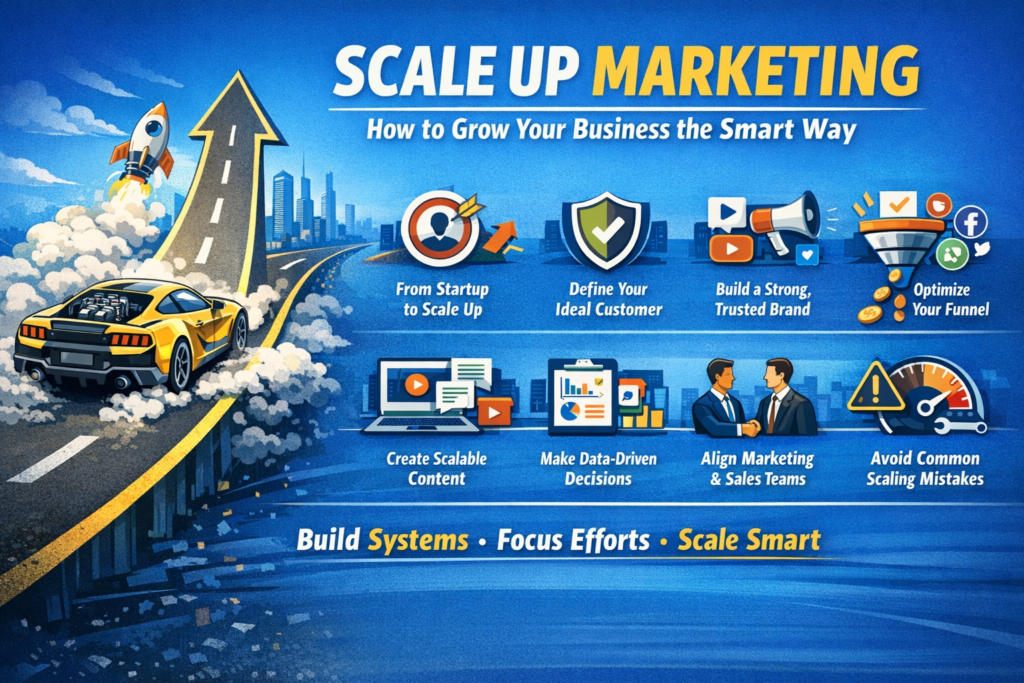
So, you’ve got a business that works. Customers are buying, your product or service is proven, and now you’re asking the big question: How do I grow this thing without everything falling apart? That’s where scale up marketing comes in.
Scale up marketing isn’t just “doing more marketing.” It’s about building a smart, sustainable system that helps you move from a small, scrappy operation into a powerful, recognized brand. You’re not testing whether your idea works anymore—you’re building engines that can run at speed.
Think of your business like a car. Startup marketing is like getting the engine started. Scale up marketing is building a stronger engine, improving the fuel efficiency, and making sure the car can handle highway speeds without blowing up. This guide walks you through exactly how to do that.
1. Understanding the Difference Between Startup and Scale Up Marketing
When you’re just starting out, your focus is survival: getting your first customers, validating your idea, figuring out the basics. You experiment a lot, try different channels, and learn what works.
Once you start scaling, the game changes:
-
You already know who your ideal customers are (or you’re close).
-
You have a product or service that people are willing to pay for.
-
You’ve proven some marketing channels that bring in results.
Now the challenge is different:
-
How do you multiply what works?
-
How do you stop wasting time on random tactics?
-
How do you grow without burning out your team or your budget?
Scale up marketing is about systems, focus, and efficiency. You move from improvisation to orchestration. Instead of throwing spaghetti at the wall, you’re building a repeatable, predictable process for attracting and converting customers.
2. Laying the Foundation: Positioning, Target Audience, and Message
Before you even think about “more traffic” or “more leads,” you need a solid foundation. Scaling a weak message just makes you fail faster.
Ask yourself:
-
Who exactly are you selling to?
-
What burning problem are you solving for them?
-
Why should they pick you instead of a competitor?
If you can’t answer those questions in one or two simple sentences, scaling will be painful.
Here’s what to get crystal clear on:
-
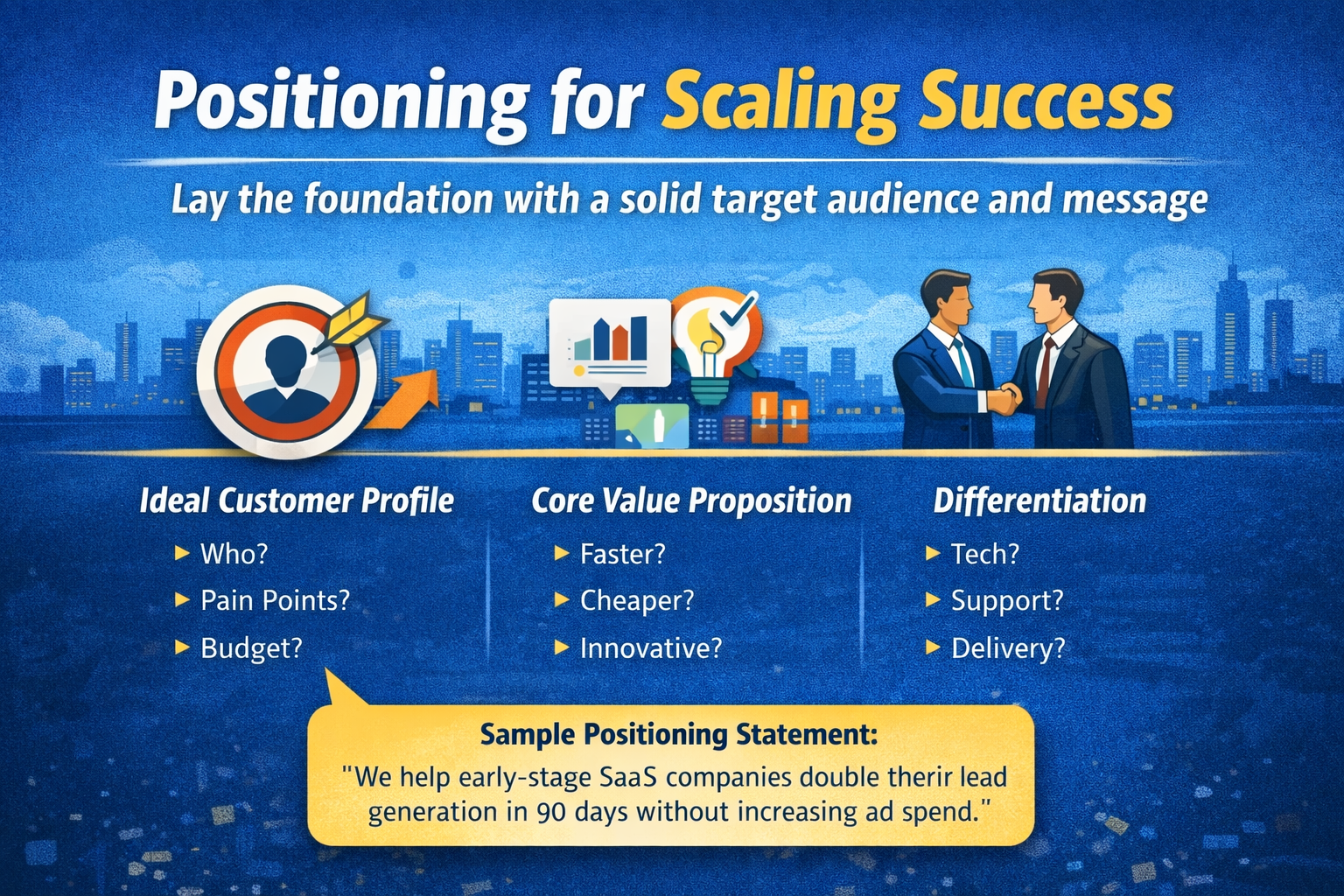
Ideal Customer Profile (ICP)
Define the type of customer that gets the best results from your product. Think industry, company size (for B2B), budget, location, and pain points. -
Core Value Proposition
What do you offer that genuinely moves the needle for your customers? Are you faster, cheaper, more reliable, more innovative? -
Differentiation
What makes you stand out? It could be your technology, your support, your brand, your pricing model, or your speed of delivery.
A strong positioning statement might look like this:
“We help early-stage SaaS companies double their lead generation in 90 days without increasing ad spend.”
Clear, specific, and outcome-focused. That’s the kind of message that scales.
3. Building a Strong Brand Before You Hit the Gas
People don’t buy from ghosts. As you grow, your brand matters more than you think. It’s not just your logo or colors; it’s how people feel about your company.
Ask yourself:
-
If someone sees your brand on social media, in an email, or during a webinar—does it feel consistent?
-
Do your website, ads, and content all sound like they’re coming from the same “voice”?
-
Do people remember you after they’ve seen you once or twice?
To scale effectively, your brand needs to be:
-
Recognizable – visually consistent, with a clear tone of voice.
-
Trustworthy – backed by testimonials, case studies, and social proof.
-
Relevant – clearly aligned with the needs and language of your audience.
Brand isn’t a “nice to have” at scale. It becomes a growth multiplier. The stronger your brand, the easier every future campaign becomes.
4. Choosing the Right Marketing Channels to Scale
Here’s the truth: you don’t need to be everywhere. You need to be where your customers are—and where your message hits hardest.
When you’re in scale-up mode, think about channels in terms of:
-
Short-term growth (fast results)
Channels like paid ads (Google, Facebook, LinkedIn), outbound sales, or influencer campaigns. -
Mid- to long-term growth (compounding results)
Channels like SEO, content marketing, email lists, partnerships.
A smart scale up strategy often combines both:
-
Use paid channels for quick wins and predictable lead flow.
-
Use content and SEO to build authority and lower acquisition costs over time.
For example, if you’re a B2B SaaS brand, you might pair LinkedIn ads and outbound email with long-form blog posts and webinars. If you’re an ecommerce brand, you might combine Google Shopping with SEO-optimized product pages and email campaigns.
The key is focus. Pick 2–4 channels that match your audience and double down. You don’t need everything—you need what works for you.
5. Turning Your Funnel Into a Machine (Not a Mess)
Scaling isn’t just about “more leads.” If your funnel leaks, more traffic just means more waste.
A simple, scalable funnel usually looks like this:
-
Awareness – People discover you (ads, social, SEO, PR).
-
Interest – They consume content, follow you, or visit your website.
-
Consideration – They sign up for a free trial, demo, lead magnet, or newsletter.
-
Decision – They buy, subscribe, or sign a contract.
-
Retention/Expansion – They stay, upgrade, and refer others.
At scale, you need to optimize each stage:
-
Are you attracting the right people at the top?
-
Do your landing pages convert visitors into leads efficiently?
-
Do your email sequences or sales processes turn leads into buyers?
-
Do you have a plan to keep existing customers engaged and loyal?
Your job is to reduce friction at every step—like smoothing out a slide so it’s easier for people to move from curious prospect to happy customer.
6. Content That Scales: From Random Posts to a True Content Engine
If your brand is the personality of your business, your content is its voice.
At scale, content does a lot of heavy lifting:
-
Educates your audience
-
Builds trust and authority
-
Improves your SEO and rankings
-
Supports your sales team with assets they can share
But here’s the catch: random content doesn’t scale. You need a planned content engine.
That means:
-
Creating pillar content (big, in-depth pieces on key topics in your niche).
-
Supporting each pillar with related cluster content (smaller articles, videos, FAQs).
-
Focusing on search intent—what people are actually looking for, not just what you feel like writing about.
-
Repurposing content across channels (blog, social, email, webinars, videos).
Think of your content like a library. When someone enters, can they find everything they need to move from confused to confident—and eventually to customer?
7. Data-Driven Decisions: Let Numbers Guide Your Growth
When you’re scaling, your gut isn’t enough. You need data.
Key metrics to watch:
-
Customer Acquisition Cost (CAC) – How much you’re spending to get a new customer.
-
Lifetime Value (LTV) – How much revenue you make from a customer over time.
-
Conversion Rates – Website visits to leads, leads to customers, trial to paid, etc.
-
Payback Period – How long it takes to earn back the cost of acquiring a customer.
Why does this matter? Because scaling without knowing these numbers is like flying a plane with no instruments. You might stay in the air for a while—but you have no idea if you’re heading into a storm.
Use data to:
-
Choose which channels to scale and which to cut.
-
Spot bottlenecks in your funnel.
-
Test offers, creatives, and landing pages.
-
Make smarter, long-term decisions instead of emotional ones.
8. Aligning Marketing With Sales and Product
As you grow, your marketing can’t live in a silo. If your marketing says one thing, sales promises another, and product delivers something else, customers will feel the disconnect.
To scale smoothly:
-
Get marketing and sales aligned on definitions of a good lead.
-
Share feedback regularly—sales should inform marketing about objections and questions prospects ask.
-
Use insights from marketing campaigns to influence product decisions.
Think of it as a relay race. Marketing hands off to sales, sales hands off to customer success. If everyone’s not running in the same direction, you lose the race.
9. Common Mistakes That Kill Scale-Up Growth
Scaling is exciting—but also dangerous if you rush it. Here are mistakes to avoid:
-
Scaling a broken funnel – If your core offer isn’t converting well, pouring more traffic into it won’t fix it.
-
Chasing every shiny new channel – TikTok, webinars, podcasts, PR, events… if you try to do everything, you’ll do nothing well.
-
Ignoring existing customers – At scale, retention and upsell can be more profitable than constant new customer acquisition.
-
Neglecting brand and trust – Short-term, “hacky” tactics might work once. Long term, trust wins.
Scaling should feel structured, not chaotic. If everything feels like a rush and nothing is documented, that’s a red flag.
10. A Step-by-Step Framework for Scaling Your Marketing
Let’s put all of this into a simple, actionable roadmap you can start using:
-
Clarify your positioning and ICP
Write down who you serve, what you do for them, and why you’re the best choice. -
Audit your funnel
Map out every step from first touch to repeat purchase. Identify where people drop off. -
Pick 2–4 core channels
Choose a mix of short-term and long-term channels based on where your audience lives. -
Build or refine your content engine
Create pillar content around your key topics and support it with related, helpful pieces. -
Launch integrated campaigns
Instead of isolated tactics, design full campaigns that cover awareness, interest, and conversion across multiple touchpoints. -
Measure relentlessly
Track CAC, LTV, and conversion rates. Run A/B tests on headlines, offers, and creatives. -
Protect and grow your brand
Keep your visual identity and messaging consistent. Collect testimonials, reviews, and case studies to showcase real-world impact. -
Scale what works, sunset what doesn’t
Double down on profitable campaigns and channels. Don’t be afraid to cut underperformers—even if you “like” them. -
Plan for new markets and segments carefully
Research cultural, legal, and competitive differences. Adapt your messaging rather than copying and pasting it. -
Keep learning and iterating
Scaling isn’t a one-time project; it’s an ongoing process. The market evolves, competitors adapt, and your customers’ expectations change over time.
Conclusion
Scale up marketing is about more than just “doing more.” It’s about doing the right things, in the right order, with the right structure behind them.
When you:
-
Know exactly who you’re serving
-
Have a clear and compelling message
-
Build a brand people trust
-
Focus on the best-fit channels
-
Use data to guide decisions
-
Keep your teams aligned
you set yourself up for sustainable, compounding growth instead of chaotic, stressful sprints.
Think of your marketing as the engine that powers your growth. You’re not just pouring more fuel into it—you’re tuning it, reinforcing it, and preparing it to run at a much higher speed. That’s what real scale up marketing looks like.