
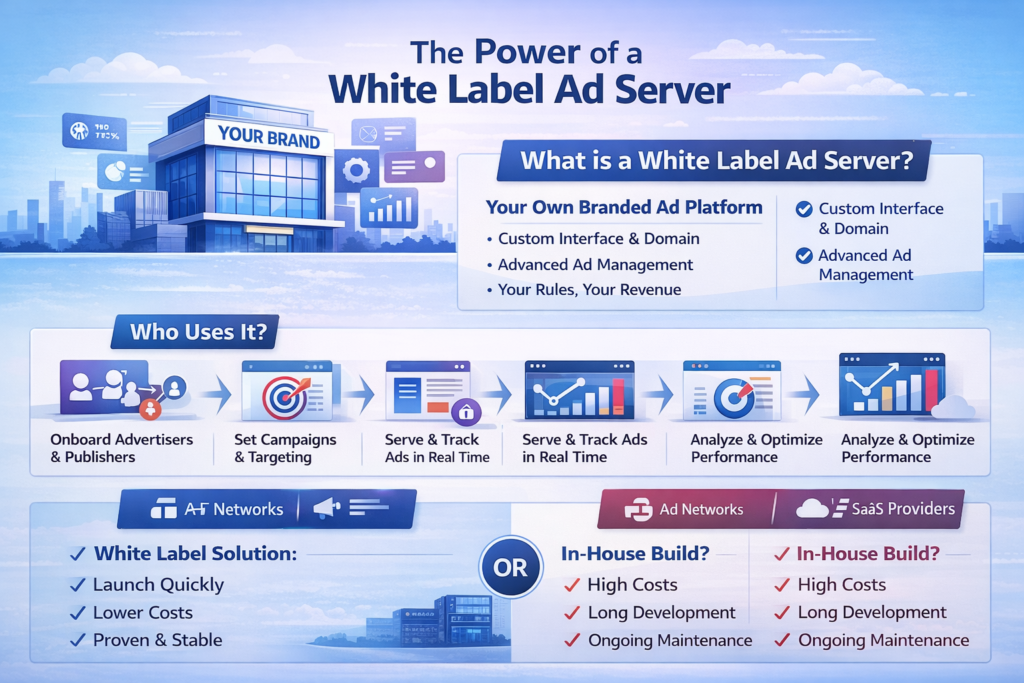
If you run an ad network, media agency or online publishing business, you’ve probably hit a wall with off‑the‑shelf ad platforms. They’re powerful, but they’re not really yours. That’s where a white label ad server comes in – a ready‑made advertising platform you can run under your own brand, with your own look, your own rules and your own revenue model.
Think of it like leasing a fully built, high‑tech building and putting your own name on the front. You don’t have to pour the concrete or design the plumbing, but you control what happens inside.
This guide breaks down what white label ad servers are, how they work, who they’re for, and how they can help you scale your ad business without spending years on development.
What Is a White Label Ad Server?
A white label ad server is an ad delivery platform built and maintained by a technology provider, but branded and configured as if it were your own in‑house solution. You get the same core functionality as a “normal” ad server – serving, tracking and optimising ads – but the interface, domain, logo, colours and often even feature set are customised for your business.
Instead of building an ad server from scratch, you:
-
License or subscribe to a mature platform.
-
Apply your brand identity and settings.
-
Offer it to your advertisers, publishers or clients as your ad platform.
To your users, it feels like a proprietary, custom solution. Under the hood, it runs on proven infrastructure that’s already tested at scale.
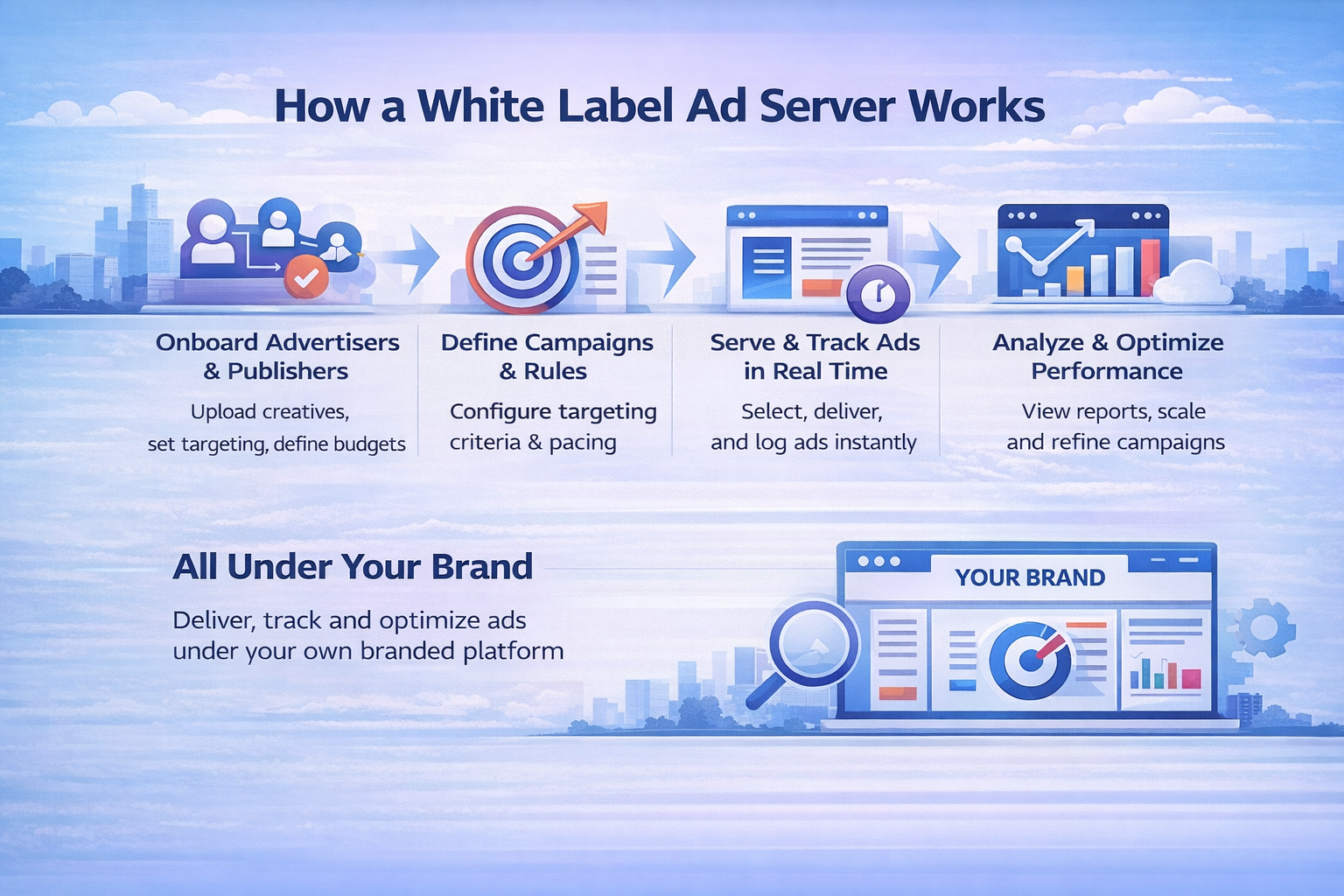
How a White Label Ad Server Works (In Plain English)
At a high level, a white label ad server works just like any capable ad serving system:
-
You onboard advertisers and publishers
-
Advertisers upload creatives, set budgets and define targeting.
-
Publishers connect their websites, apps or placements where ads will appear.
-
-
You define campaigns and targeting rules
-
For example, “show this banner to UK users aged 25–44 interested in travel,” or “prioritise high‑CPM campaigns during peak traffic hours.”
-
-
The ad server handles requests in real time
-
When a user visits a page or opens an app, the placement sends a request to the server.
-
The platform decides which ad to show based on your rules, pacing, frequency caps and other logic.
-
-
Ads are delivered and tracked
-
The user sees the ad; the platform logs impressions, clicks, conversions and other events.
-
You and your clients can view performance dashboards and reports.
-
-
You optimise and scale
-
You shift budgets, tweak targeting, test new formats and onboard more partners – all under your brand.
-
The big difference from generic tools is control. You’re not just one more client in someone else’s platform; you’re running the platform for your own ecosystem.
Key Features You’ll Usually Get
Different vendors offer different tools, but most serious white label ad servers tend to share a recognisable core feature set:
-
Branded interface and domain
Your logo, colours, email templates and even system URLs, so advertisers and publishers log into your platform. -
Multi‑tenant access
Separate accounts or roles for advertisers, publishers, account managers and admins, each with the right permissions. -
Advanced targeting options
Geo, device, OS, browser, language, time of day, frequency caps, retargeting segments and more. -
Support for multiple ad formats
Display, native, video, mobile, in‑app, possibly connected TV or audio depending on the provider. -
Real‑time reporting and analytics
Impressions, clicks, CTR, conversions, eCPM, revenue, spend, and sometimes more granular event tracking. -
Automation and optimisation tools
Rules for pausing under‑performing campaigns, pacing budget, A/B testing creatives and managing day‑parting. -
API and integrations
Hooks into your CRM, billing system, BI tools or other marketing platforms so you can build workflows around your ad server.
The aim is to give you everything you’d expect from a modern ad tech stack, without you hiring a whole engineering team to build it.
Who Uses White Label Ad Servers?
Several types of businesses can benefit from white label ad servers, often for slightly different reasons:
-
Ad networks
They aggregate inventory from many publishers and sell it to advertisers. A white label ad server lets them run the entire network from a platform that carries their name and rules. -
Digital agencies and media buying teams
Agencies can offer their own “proprietary” ad tech to clients, adding value and creating new revenue streams while keeping campaign management in‑house. -
Publishers and media groups
Large publishers can manage multiple sites or apps, sell direct campaigns, run private marketplaces, and retain full control over yield and ad experience. -
SaaS and martech providers
Some software companies add white label ad serving as a feature in a broader marketing platform, boosting their perceived sophistication without reinventing the wheel.
If you’re managing significant ad spend, juggling multiple publishers or clients, or trying to differentiate your services, a white label solution often makes a lot more sense than stitching together basic tools.
Key Benefits of Choosing a White Label Ad Server
Why would you choose a white label solution instead of building your own or sticking with generic platforms?
Here are the main advantages people care about.
-
Faster time to market
Building an ad server from scratch is incredibly complex. You need specialists in real‑time bidding, scalable infrastructure, security, privacy compliance and more. A white label platform lets you launch your “own” ad server in weeks instead of years. -
Huge savings on development and maintenance
Ongoing engineering costs, hosting, monitoring, feature updates and bug fixes add up fast. With a white label model, the vendor shoulders most of this burden. You focus on growth, sales and client relationships, not low‑level tech. -
Brand ownership and differentiation
Instead of sending clients to someone else’s dashboard, you invite them into yours. That reinforces your brand and makes it harder for clients to see you as a commodity service they can easily replace. -
Control over features and roadmap
You don’t get full “source code” control, but you do get more influence over features than a standard customer. Many providers offer modular options and customisations that let you shape the platform around your business model. -
Scalability and reliability
Established vendors usually run infrastructure designed to serve billions of impressions. As you grow, you inherit that scalability rather than scrambling to expand your own servers and load balancing. -
Better margins and new revenue lines
You can charge platform fees, minimum spends or seat licences on top of media margins. Over time, the platform itself can become a profit centre rather than just a cost of doing business.
For a lot of companies, the combination of lower risk, faster launch and higher perceived value is the real game‑changer.
Essential Considerations When Choosing a White Label Ad Server
Not all platforms are created equal. Before you sign any contract, it pays to slow down and evaluate your options carefully.
Here are key questions to ask:
-
Does it support the formats and channels you need?
If you rely heavily on video, native or in‑app traffic, make sure those formats are first‑class citizens in the platform. -
How flexible is the branding?
Can you customise the UI, login pages, email notifications and domains enough to make it feel genuinely yours? -
What about reporting depth and data access?
Do you get detailed, exportable data? Can you access raw logs or connect to external BI tools if needed? -
How transparent is pricing and billing?
Is pricing based on impressions, seats, features or revenue share? Make sure you understand how costs scale as your volume grows. -
What’s the level of support and onboarding?
Do you get a dedicated account manager? Training for your team? Documentation and SLAs that match your risk tolerance? -
Is the vendor serious about privacy and compliance?
With regulations like GDPR and evolving industry standards, you need a partner that treats data protection as a first‑class requirement.
Taking the time to check these points up front will save you headaches – and costly migrations – later.
White Label Ad Server vs Building Your Own
Sometimes teams get tempted by the idea of building a completely bespoke, in‑house ad server. On paper, it sounds appealing: total control, no vendor lock‑in, unique features. In practice, it’s usually far more challenging than it looks.
Building your own ad server often means:
-
Hiring specialised engineers and architects.
-
Dealing with latency, uptime, scaling and global delivery.
-
Constantly patching, updating and securing the platform.
-
Investing months or years before you have something competitive.
A white label solution trades absolute control for pragmatism. You get:
-
A mature platform quickly.
-
A predictable cost model.
-
A clear path to market and revenue.
For most agencies, networks and publishers, that trade‑off is worth it – especially in an industry that moves as fast as ad tech.
Learning More About Ad Serving and Best Practices
If you want to deepen your understanding of ad serving concepts – impressions, viewability, targeting logic, tracking and measurement – it’s worth exploring broader educational resources on advertising technology and web standards. For example, the documentation that large platforms and standards bodies publish on advertising, measurement and user experience can help you evaluate white label vendors and design better setups for your own clients:
https://developers.google.com/
High‑quality reference material like this gives you a solid foundation so you’re not just trusting vendor sales pitches; you can ask sharper questions and design smarter workflows.
Conclusion
A white label ad server gives you the power of a sophisticated ad tech platform without the pain of building and maintaining it yourself. You get your own branded system where advertisers and publishers can collaborate, run campaigns and analyse performance – all under your banner, not someone else’s.
For ad networks, agencies and ambitious publishers, this can be the difference between being “just another media buyer” and becoming a true platform in your niche. With the right partner, you can launch faster, control more of the value chain and focus your energy where it matters most: growing relationships, revenue and results.